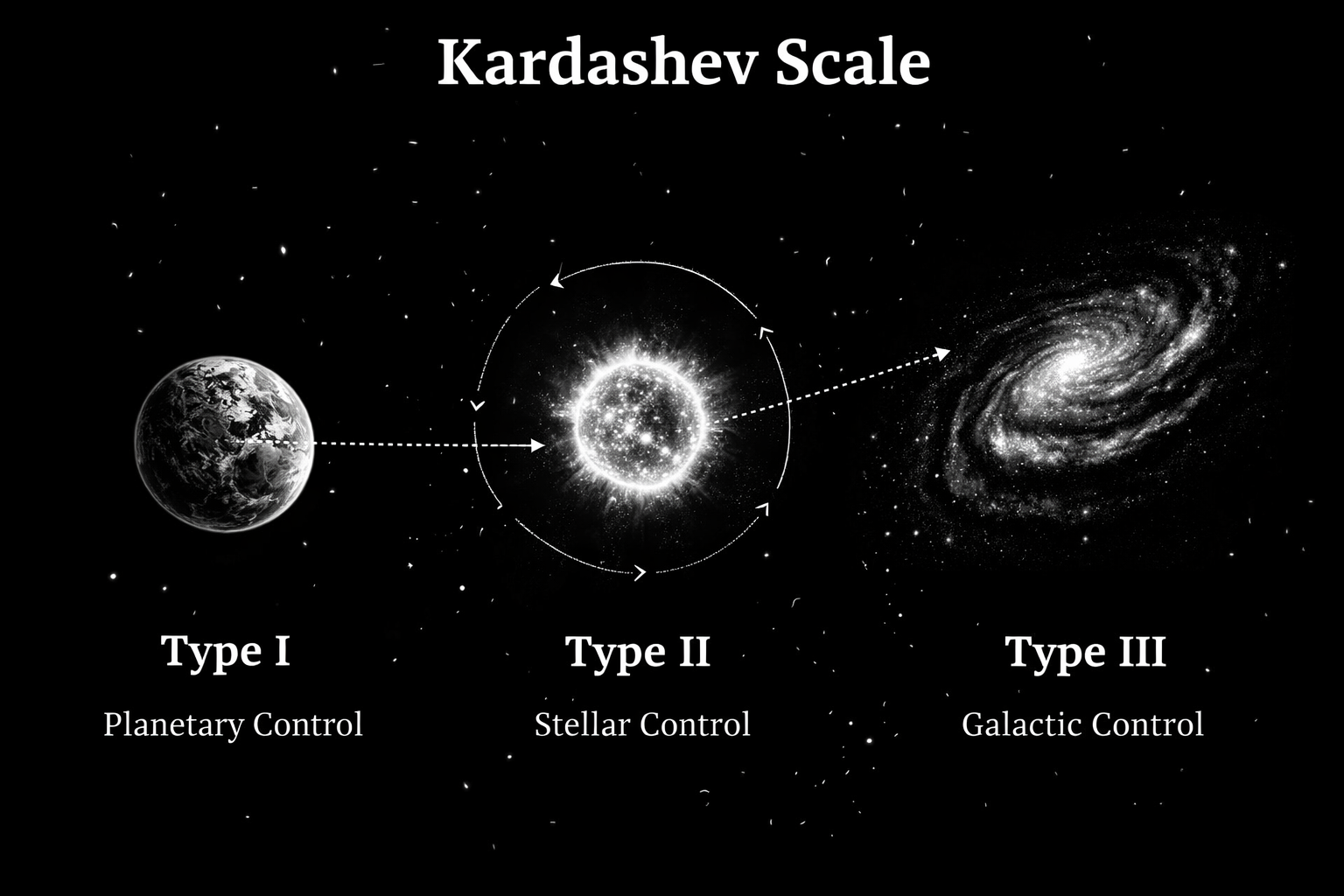
In 1964, Soviet astrophysicist Nikolai Kardashev proposed a bold idea: a civilization’s advancement can be measured by how much energy it controls. A Type I civilization controls all planetary energy. Type II controls its star’s energy. Type III commands energy across its galaxy. Humanity today stands at roughly 0.7 — not yet Type I, still struggling to fully manage Earth’s resources. The scale assumes that progress equals greater control over external energy. It is a technological definition of evolution.
Hindu spirituality defines evolution differently.
In the Upanishads, ultimate reality is described as Brahman — infinite, all-pervading consciousness underlying the universe. Here, progress is not measured by how much energy one commands externally, but by how deeply one realizes inner unity. Spiritual development is described as mastery over the mind, senses, ego, and desires. It is internal expansion, not external conquest.
Kardashev speaks of outer energy.
Adhyatmic Vikas speaks of inner awareness.
"Kardashev baahari urja ko naapta hai.
Adhyatmik vikas antar ki chetna ko jagata hai."
Both frameworks describe levels of development. Both imagine expansion from smaller to greater scales. Hindu cosmology speaks of Lokas — layered realms from Bhuloka to Brahmaloka. The Kardashev Scale speaks of planetary, stellar, and galactic control. Both envision growth, but their definitions of growth differ fundamentally.
The real tension lies not in comparison, but in consequence.
Humanity is rapidly increasing technological power — artificial intelligence, nuclear capability, space exploration, genetic engineering. These are steps toward higher external control. But ethical maturity has not grown at the same rate. Climate crisis, geopolitical conflict, and resource inequality reveal a dangerous imbalance.
"Kardashev scale poochta hai: Hum kitni urja ko niyantrit karte hain?
Hindu darshan poochta hai: Humein niyantrit karne wali shakti kaun hai?"
If inner development does not accompany outer expansion, power becomes destabilizing. A Type I civilization without moral evolution may destroy its own planet before reaching Type II. Technology amplifies intention; it does not purify it.
Hindu thought introduces concepts like dharma (moral order), moksha (liberation), and Atman (true self) to argue that real advancement is awareness-driven. External growth without inner clarity leads to imbalance. Inner evolution without engagement with the world leads to stagnation. Sustainable progress requires integration.
There is no historical connection between the Kardashev Scale and Hindu spirituality. One emerges from astrophysics and the search for extraterrestrial intelligence. The other arises from ancient philosophical inquiry. But philosophically, they converge on a central question: What does it mean to evolve?
Civilization may reach the stars.
The real question is whether it will reach wisdom first.
If humanity aspires to Type I, II, or III status, the greater challenge may not be engineering — it may be ethics. Outer energy must be balanced with inner clarity. Without it, progress risks becoming self-destruction.
True evolution may not be choosing between science and spirituality, but aligning them — ensuring that as our power grows, our awareness grows faster.
That is the real test of an advanced civilization.