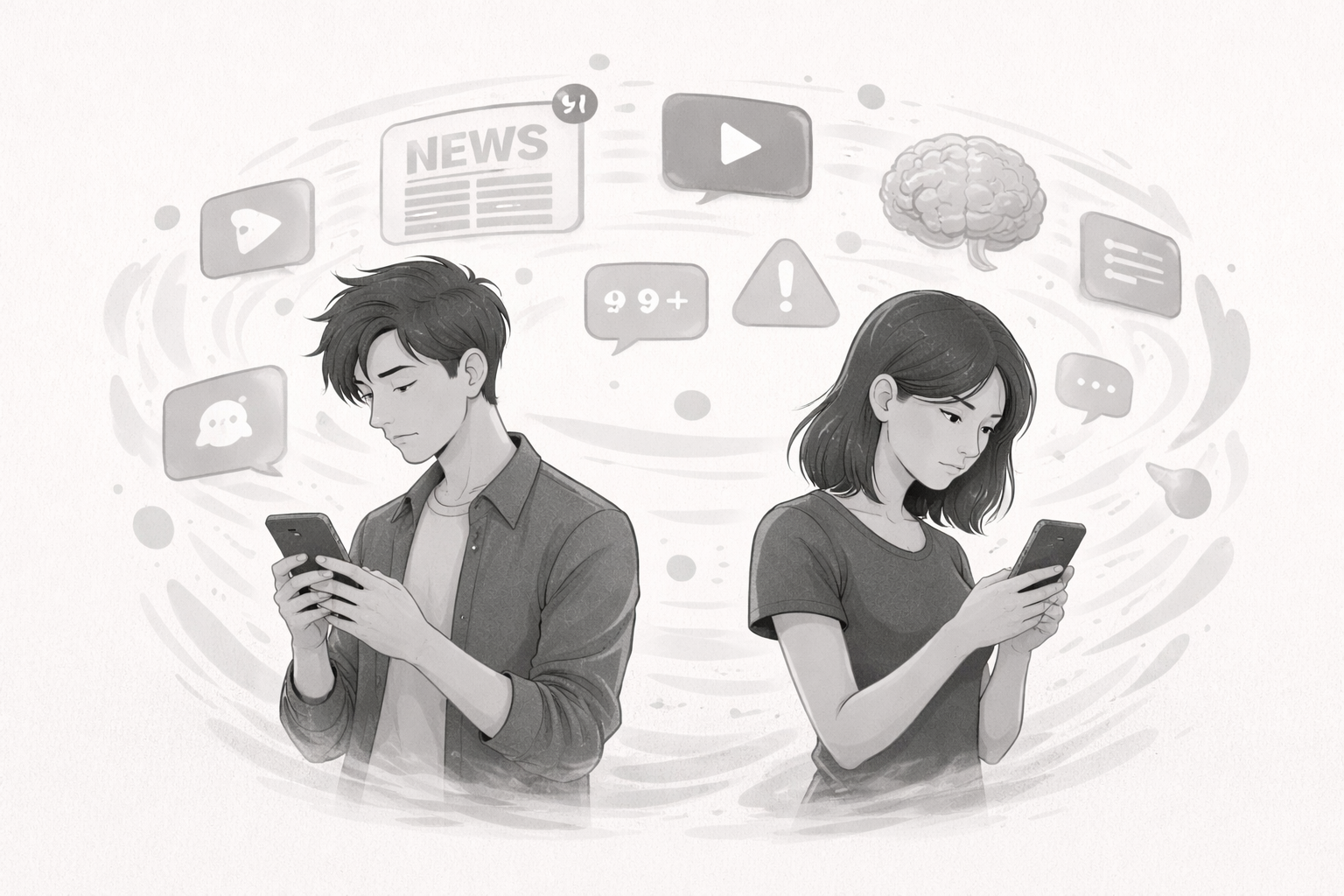
Media no longer merely reports reality. It organizes it. What people notice, ignore, fear, and desire is increasingly shaped by digital systems designed to maximize attention rather than understanding.
Information now moves without pause. News, entertainment, opinion, and outrage flow continuously across screens. The mind is rarely allowed to rest, evaluate, or withdraw.
What we encounter repeatedly does not remain external.
It gradually becomes part of how we think.
Repeated exposure to simplified narratives influences belief more than deliberate reflection. Over time, individuals absorb assumptions without recognizing their origin. Opinions begin to feel personal, even when they are inherited.
Algorithms reward emotional reaction. Anger, fear, and excitement generate engagement. Careful analysis does not. As a result, public conversation becomes louder and less thoughtful.
Systems built for engagement inevitably weaken habits of critical thinking.
Constant stimulation fragments attention. Reading becomes difficult. Silence becomes unfamiliar. The ability to remain with a single thought declines quietly.
The mind adapts to speed. Stillness begins to feel uncomfortable. Absence of input is interpreted as emptiness rather than recovery
Psychological fatigue accumulates gradually. Comparison intensifies insecurity. Continuous exposure produces anxiety without clear cause. Mental overload becomes normal.
A distracted mind loses the capacity for accurate judgment.
Healthy media use is not a matter of moderation alone. It requires active selection, skepticism toward sources, and deliberate limitation. Without these, consumption becomes passive and compulsive.
Choosing fewer inputs strengthens perception. Questioning narratives restores independence. Creating intervals of silence protects mental coherence.
When media is approached consciously, it informs and clarifies. When accepted uncritically, it shapes behavior and exhausts attention
The difference lies not in technology itself, but in the discipline with which it is used.