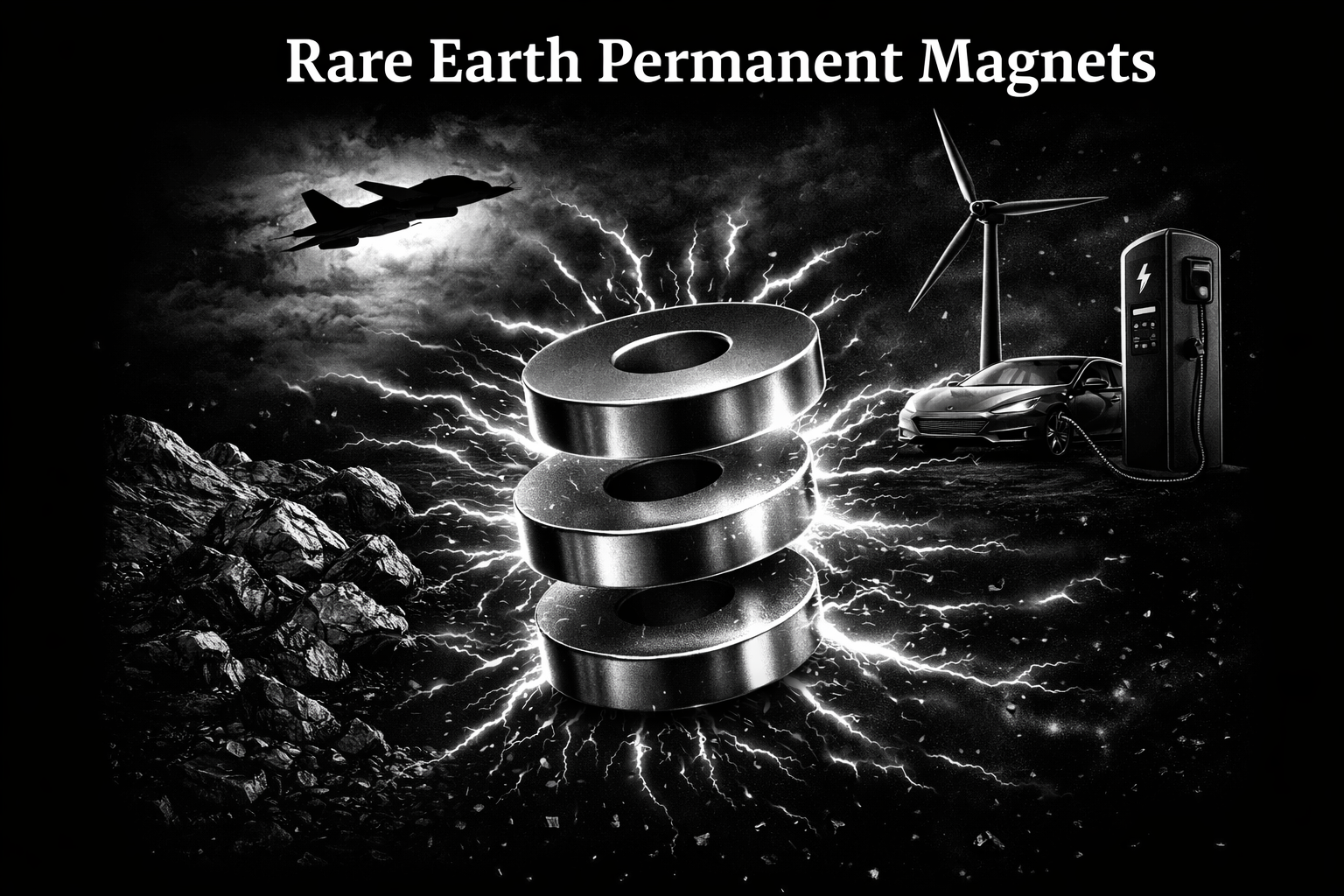
Rare earth permanent magnets are among the most critical industrial materials of the modern era. They are essential for electric vehicles, renewable energy, advanced electronics, and military technology.
Despite their importance, their global supply chain is highly concentrated, environmentally damaging, and politically sensitive. Claims about being “fifth largest” are often misleading without proper context.
Rare earth magnets drive modern technology,
but their supply is shaped by power and politics.
What Are Rare Earth Permanent Magnets?
Rare earth magnets are extremely strong permanent magnets made from rare earth elements. These elements were first identified in the late 1700s.
In 1949, major deposits were discovered in California, leading to large-scale production in the United States. During the 1980s, China expanded mining, refining, and manufacturing and became the global leader.
These magnets are far stronger than ordinary iron or fridge magnets, which is why they are widely used in modern technology.
Types of Rare Earth Magnets
There are two main types of rare earth permanent magnets.
Neodymium-Iron-Boron (NdFeB)
Made from neodymium, iron, and boron. These are the strongest
permanent magnets in the world and are used in phones, laptops,
motors, and electric vehicles.
Samarium-Cobalt (SmCo)
Made from samarium and cobalt. These magnets are heat-resistant and
mainly used in aerospace and military systems.
Manufacturing Process
Rare earth magnets require a complex industrial process involving mining, chemical separation, alloy production, powder processing, sintering, coating, and final assembly.
Each stage demands advanced technology, skilled labor, and strict environmental control.
Mining is only the beginning.
Processing creates power.
The Global Supply Chain Reality
China dominates most stages of the rare earth supply chain, from mining to finished magnet production. This gives it strong control over global supply.
Many countries have reserves, including the United States, India, Australia, and Russia, but lack advanced processing facilities.
As a result, most nations remain dependent on imports despite having natural resources.
Environmental and Political Challenges
Rare earth processing requires large amounts of chemicals and produces toxic and radioactive waste. Poor management contaminates soil and water.
Because these materials are vital for defense and renewable energy, governments treat them as strategic assets.
Export controls, subsidies, and stockpiles are increasing worldwide, raising supply risks.
India as a Case Study
India has large reserves in coastal monazite sands and is often ranked among the top five globally.
However, mining output and processing capacity remain limited. India imports most finished magnets due to weak downstream infrastructure.
Government initiatives after 2023 aim to build refining and manufacturing capacity, but results will take many years.
Resources alone do not create independence.
Geographic Distribution of Deposits
Major deposits occur in coastal sands in India and Southeast Asia, bastnäsite ores in China and the United States, ionic clays in southern China, and hard-rock deposits in Brazil, Russia, and Australia.
Each deposit type requires different extraction methods, affecting cost and environmental impact.
Structural Risks and Limitations
Developing a full supply chain outside China takes five to ten years and requires massive investment.
Higher labor costs, strict regulations, and waste management increase production expenses.
NdFeB magnets have no scalable commercial substitute for high-performance applications.
Recycling exists but remains limited and costly.
Conclusion
Rare earth permanent magnets are the invisible backbone of modern technology. Their production is concentrated, environmentally risky, and geopolitically sensitive.
China maintains dominance through long-term industrial strategy and manufacturing strength.
Although many countries are trying to diversify supply, meaningful change will take decades of sustained investment.
Rare earth magnets will remain a major strategic bottleneck in the global economy for the foreseeable future.
Control processing, or depend forever.