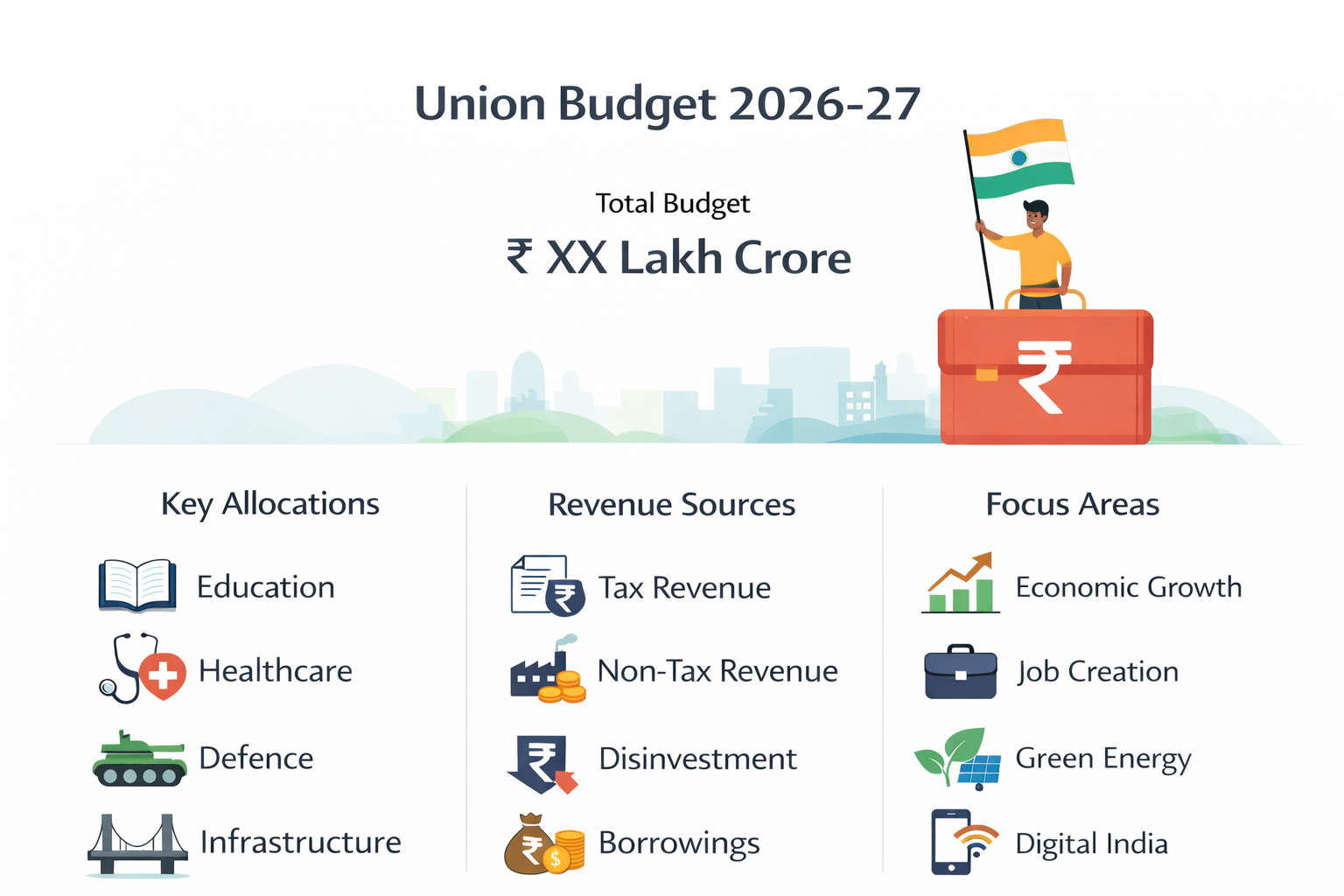
The 9th Union Budget for 2026–27, presented by Finance Minister Nirmala Sitharaman on February 1, 2026, outlines the government’s fiscal priorities in an increasingly complex economic environment. With an estimated expenditure of ₹53.5 lakh crore—representing a 7.7% increase over the previous year—the budget emphasizes macroeconomic stability, structural reform, and sustained public investment.
A major highlight is the introduction of the New Income Tax Act, 2025, effective from April 1, 2026, replacing the Income Tax Act of 1961. The emphasis is on simplification and administrative efficiency.
System reform matters more than short-term relief.
Tax Reforms and Compliance
-
New Income Tax Act, 2025 : The old income tax law, which was more than 60 years old, was confusing and complicated, with many difficult sections. The new Income Tax Act 2025 is simpler, with easy forms and clearer sections. This makes compliance easier for taxpayers. (Profit compared to previous law).
-
Motor accident intrest reduced to free : Earlier, interest received from motor accident compensation was taxed at around 20%. Now, this interest is completely tax-free.
-
Earlier the TCS on Foreign Travel & LRS tax : Earlier, TCS on foreign travel and LRS payments was around 5% to 20%. Now, it has been reduced to 2%. This means that on overseas spending, TCS is much lower (for example, around ₹10,000 on ₹5 lakh). For education and medical expenses abroad, the tax has been reduced from 5% to 2%.
-
TDS on Manpower Services : For TDS on manpower services, there was earlier a lot of confusion about whether payments were for contractors or professionals, and wrong rates were often applied. Earlier, it was around 10%. Now, it is fixed at 1% to 2% and treated as contractor payments.
-
Automated Lower / Nil TDS Certificate : Earlier, getting a lower or nil TDS certificate involved long delays, manual processes, and sometimes corruption. Money was blocked for months. Now, the process is fully online and automated, giving faster approval and immediate relief.
-
Form 15G / 15H via Depositories : Before the new law, Form 15G and 15H had to be submitted separately to each company, which was repetitive and time-consuming. Now, it can be submitted once to the depository and applies to all companies.
-
Return Revision Deadline: Earlier, the last date to revise returns was 31 December. Now, it has been extended to 31 March, giving three extra months, with a small late fee if missed.
-
New ITR Filing Deadlines : Earlier, most taxpayers had to file their returns by 31 July. Now, individuals using ITR-1 and ITR-2 still have the same deadline, but non-audit businesses get one extra month till 31 August. This gives business owners more time to prepare accounts and avoid mistakes. It reduces last-minute rush and pressure on the tax system.
-
Property Sale by NRI – TAN Removed : Earlier, when buying property from an NRI, the buyer needed a TAN, which involved extra registration and delays. Now, only PAN and a simple challan are required, making the process easier.
These reforms aim to simplify taxation and make compliance faster, fairer, and more transparent.
Key Sector Allocations
- Finance Ministry – ₹19.72 lakh crore (highest due to interest and transfers)
- Defence – ₹7.85 lakh crore
- Transport – ₹5.98 lakh crore
- Rural Development – ₹2.73 lakh crore
- Home Affairs – ₹2.55 lakh crore
- Agriculture – ₹1.40 lakh crore
- Education – ₹1.39 lakh crore
India’s ₹1 Lakh Crore Leap
-
Biopharma Shaky Initiative: The Biopharma Shaky Initiative will invest ₹10,000 crore over five years to move India from mainly making generic medicines to developing advanced biologic drugs. It will build living labs, bioreactors, and clinical trial centers to support research and innovation.
-
Semiconductor Mission: The Semiconductor Mission aims to help India design and own its own computer chips instead of only assembling them. This will reduce imports, create high-quality jobs, and strengthen Indian technology products.
-
Rare Earth Permanent Magnets: Rare earth minerals are used in EVs, smartphones, and wind turbines, making them essential for modern technology. India has the world’s 5th largest reserves but mostly exports them in raw form, earning low profits. Other countries process these materials and make high-value products. India plans to process them locally, build special industrial corridors, and allow duty-free machines. This will help shift toward high-value manufacturing.
-
Domestic Chemical Production (₹600 Cr): The government has allocated ₹600 crore to build three chemical parks. These parks will support large-scale manufacturing, reduce import dependence, improve supply security, and strengthen the industrial base.
-
Construction & Infrastructure Equipment: Local manufacturing of tunnel boring machines and high-speed elevators will reduce costs, accelerate projects, and strengthen India’s engineering and manufacturing sector.
-
Container Manufacturing Scheme (₹10,000 Cr / 5 Years): An investment of ₹10,000 crore over five years will support domestic container production, lower logistics costs, and improve export efficiency.
-
National Fiber & Electronic Components: An outlay of ₹40,000 crore will boost electronics manufacturing, including circuit boards, sensors, and capacitors, strengthening India’s technology supply chain.
Strategic investments aim to build domestic manufacturing strength and reduce India’s dependence on imports.
Employment & Skill Development
The Union Budget 2026–27 aims to create more jobs and improve skills among young people. It focuses on training, supporting small businesses, encouraging startups, and expanding apprenticeship programmes. The main goal is to make students and job-seekers ready for real work in manufacturing, services, technology, and digital industries.
These large-scale investments are expected to generate employment and improve skill development by building training centres, offering job-based learning, and helping businesses grow. The government aims to transform India’s youth population into a skilled and productive workforce.
If implemented effectively, these policies have the potential to generate millions of quality jobs and strengthen India’s long-term economic competitiveness.
Although the government has not provided exact figures, experts believe that these policies could generate millions of jobs in the coming years.
Positive Effects
-
Youth Employment: Greater emphasis on education, modern skills, and technology-based learning will improve employment opportunities for young people.
-
Skill Training & Apprenticeships: Increased funding for training centres, apprenticeships, and on-the-job learning will help students gain practical work experience.
-
MSMEs (Small Businesses): Improved access to loans, funding, and financial support will enable small and medium enterprises to expand and generate employment.
-
Startups: A more supportive business environment will encourage innovation, leading to new enterprises and job creation.
Negative Effects and Challenges
-
Implementation Problems: Poor programme management and mismatch with industry needs may limit employment outcomes.
-
Business Difficulties: Complex regulations and paperwork may continue to hinder small businesses and startups.
-
Unequal Benefits: Regional and social disparities may result in uneven distribution of benefits.
-
Market Concerns: Certain policy changes have raised investor concerns, affecting market confidence.
Healthcare, Education & Environment
Along with economic growth, the budget must also strengthen human development. The Union Budget 2026–27 focuses on healthcare, education, and environmental sustainability to improve overall quality of life.
Long-term national progress depends not only on economic expansion, but also on strong investments in health, learning, and environmental protection.
In healthcare, increased funding has been allocated for hospitals, medical education, insurance coverage, and training health workers, particularly in rural areas. While this can improve access to treatment and doctors, experts note that current funding may still be insufficient for all villages and small towns.
In education, the budget supports digital learning platforms, skill development centres, teacher training, and modern courses in artificial intelligence and technology. These initiatives aim to make students job-ready, although limited internet access and weak infrastructure in some regions may restrict their effectiveness.
For the environment, the budget promotes renewable energy, clean technologies, and climate-friendly projects to reduce pollution and support sustainable growth. However, stronger policy action and greater financial commitment are required to address climate change and air quality challenges.
Overall, the budget seeks to enhance public health, education standards, and environmental protection. Its long-term impact will depend on effective implementation and equitable distribution of benefits, particularly for rural and economically weaker communities.
Challenges and Limitations
Despite several reform initiatives, the Union Budget 2026–27 continues to face significant challenges and structural limitations. Critics and analysts have highlighted multiple areas where policy measures remain insufficient.
Sustainable economic growth requires not only strong investment, but also inclusive policies that directly address employment, inflation, and social inequality.
-
Job Gaps: The budget does not clearly specify the number of jobs to be created or present a comprehensive strategy to reduce unemployment. As a result, youth and rural employment gaps may persist.
-
Inflation and Weak Relief: Rising prices of essential goods have not been matched with adequate relief measures. Many households continue to face financial pressure, particularly in food and fuel expenses.
-
Limited Support for Ordinary Citizens: Critics argue that the budget favours large corporations, while workers, small traders, farmers, and labourers receive insufficient social and financial support.
-
Regional Inequality: Several states and regions have expressed concern that local development needs were overlooked. Rural, tribal, and economically weaker areas remain under-supported.
-
Social Gaps and Inequality: High levels of income and social inequality continue to exist. The budget does not introduce strong new mechanisms to reduce disparities in healthcare, education, and rural income.