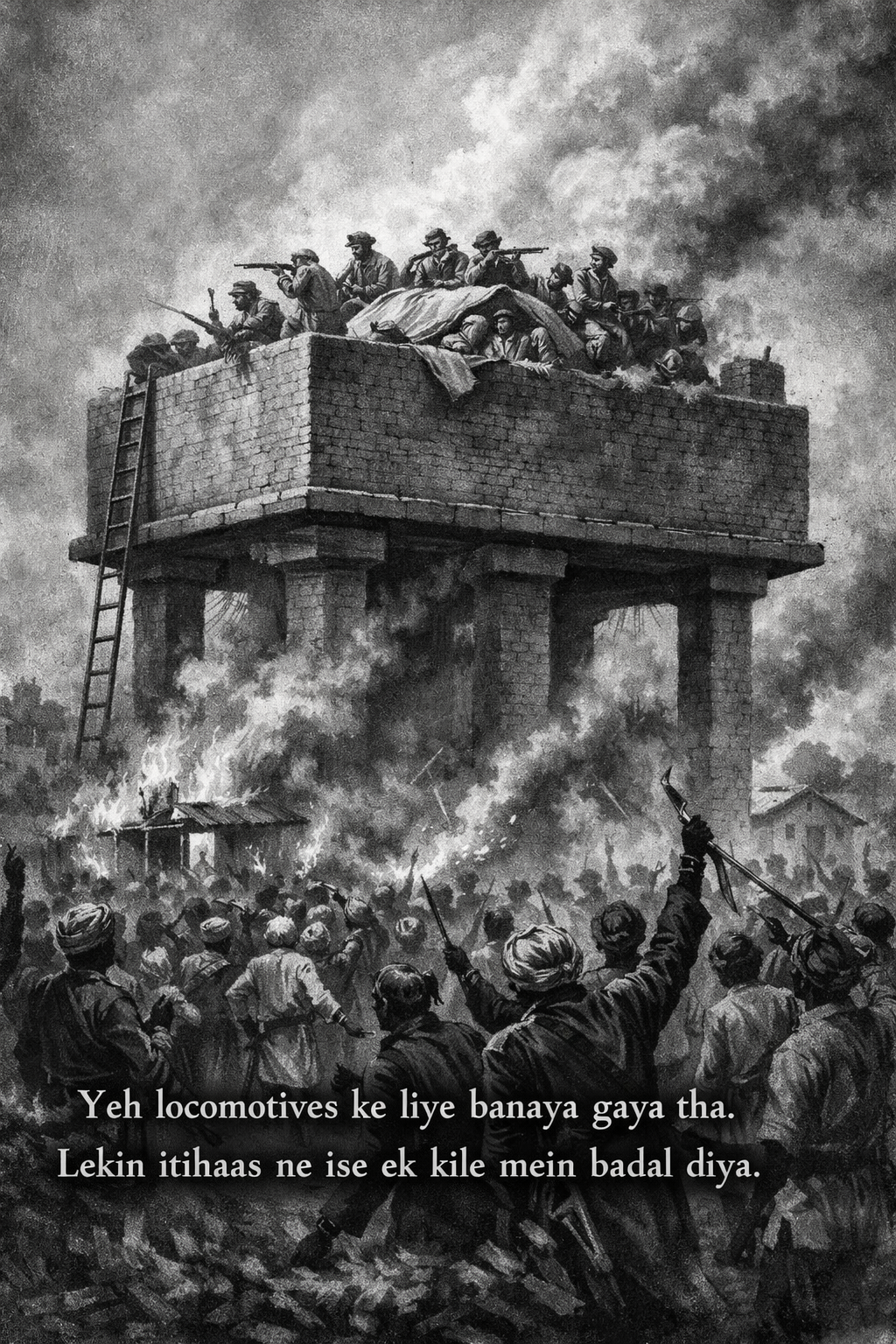
One of the darkest and most violent chapters in Indian history unfolded during the Revolt of 1857. It was not a distant battlefield, but a moment where ordinary land, railway structures, and human bodies became part of a brutal struggle for survival and revenge
Between June 7 and June 9, 1857, near the small village of Barwarie, approximately 23 miles (37 km) from Allahabad (now Prayagraj), a railway water tank became an unlikely fortress. It was never designed for war. It was built only to feed steam locomotives — a silent servant of empire. But in those three days, it became the only barrier between life and violent death.
The structure itself was simple yet imposing: a brick water tank
standing 18 feet high, 22 feet long, and 24 feet wide, holding water
at a depth of four feet. Built to sustain machines, it was never meant
to sustain human lives under siege.
But history had other plans.
"Yeh locomotives ke liye nirmit tha, par itihaas ne ise jeevit rehne ke antim kile mein badal diya."
The Collapse of Safety
On June 7, 1857, the illusion of safety shattered. A railway inspector, Mr. Lancaster, was murdered nearby while attempting to reach his colleagues. His death was not quiet. It was a signal. A warning. It meant the violence had arrived at their doorstep.
The railway officers, engineers, women, and children understood immediately: they were no longer administrators of colonial infrastructure. They were targets
Fear moved faster than thought.
With no time and no alternatives, they abandoned their bungalows and climbed onto the elevated railway water tank — men, women, and children alike. Even the elderly struggled upward. Below them, the land they once occupied had turned hostile.
They did not climb for comfort.
They climbed because it was the only place where death might be
delayed.
The Siege
Soon, they were surrounded.
Not by soldiers alone, but by villagers, armed rebels, and zamindars — men driven by rage, loss, and years of accumulated resentment. Their numbers grew rapidly, until nearly 3,000 people stood below the tank, forming a human wall of hostility.
The attackers looted and destroyed the railway bungalows first. Doors were ripped from hinges. Windows shattered. Furniture burned. Everything that symbolized authority was reduced to ash.
Then they turned their attention upward.
Stones, bricks, and debris were hurled relentlessly toward the trapped group. There was no shelter on the tank. No roof. No protection from impact or heat. Women and children crouched beneath mattresses, fragile barriers against violence raining from below.
The sun offered no mercy either.
It was June. Peak summer in northern India. The sky burned without interruption. The exposed brick tank absorbed heat, turning into a slow instrument of suffering. The air itself became suffocating
"Upar se jhulasati hui dhoop unke shareer ko tod rahi thi, aur neeche Bharatiya sashastra vidrohi chupchaap maut ka intezar kara rahe the."
The scorching sun above was breaking their bodies, while below, armed rebels waited silently for death to claim them..
Fire, Hunger, and Endurance
The attackers demanded money. In desperation, the trapped group threw down 3,000 rupees — a fortune at the time — hoping to buy time. But money did not end the siege. It only prolonged it.
Then came fire.
Straw and fuel were piled around the base of the tank and ignited. Smoke rose upward, choking the trapped survivors. Heat intensified. Breathing itself became painful. Still, they did not descend.
Because stepping down meant immediate death.
For 52 continuous hours, they remained exposed — with almost no water, almost no food, and no certainty of rescue. Time stopped functioning normally. Every minute stretched into suffering.
They were not soldiers in battle.
They were human beings waiting to see whether rescue or death would arrive first.
The Breaking Point
At one point, a wounded railway inspector managed to reach the tank. His companion had been killed while escaping. He was pulled up with ropes, barely alive. Now, 15 survivors remained trapped together, suspended between sky and ground, between survival and annihilation.
Finally, a message reached Allahabad.
On June 9, 1857, after two days of siege, 35 cavalry soldiers arrived.
The siege ended.
But survival came at a cost.
One woman, Mrs. Ryves, collapsed and died shortly after rescue — not from weapons, but from heat, dehydration, and exhaustion. Her body had endured more than it could survive.
The tank had saved them.
But it could not save everyone.
The Raw Truth Behind the Violence
This incident was not random. It was born from deeper forces.
Years of colonial oppression, economic exploitation, land dispossession, and cultural interference had created unbearable tension. Railways, though technological achievements, were also instruments of imperial control — used to move troops, extract resources, and enforce authority.
To many villagers, railway officers were not neutral civilians.
They were symbols of the system that had reshaped their lives without
consent.
The railway water tank became more than infrastructure.
It became a battlefield of survival, rage, and collapse of order.
"Yeh paani ka tank yudh ke liye nirmit nahi tha. Phir bhi yeh nishabd khada raha, jab itihaas is par apna sach likh raha tha."
Conclusion
The Elevated Railway Water Tank at Barwarie was never meant to witness war. It was meant to serve locomotives, not human desperation. Yet, for three days in June 1857, it became the last refuge for people trapped between the burning sky and an unforgiving ground.
It stood silently as heat, fear, and violence tested the limits of
human endurance.
It did not choose sides.
It simply stood there — while history unfolded upon it.